🧭 Teaching Sequence: Week 5, first science lesson. Teach it Monday, right after Transmission 5.
| Subject | Science: Earth Science and Engineering Design |
| Week Theme | Staying Safe |
| Lesson | Slow Down Erosion |
| Time | About 55 minutes |
| Grade Level | 2nd Grade (adaptable for Grades 1–4) |
| Resources | Transmission 5 · Erosion Challenge Plan and Test · Make Your Own Erosion! (video) · Soil Erosion and Conservation (video) |
| Materials | The Survival Plan; sticky notes; for each team: a foil pan or tray, damp sand, a paper cup, an index card, and a “rain cup” (a paper cup with five pencil holes in the bottom), plus one rain cup for your demo; a measuring cup and a pitcher of water; clear plastic cups; craft sticks, pebbles, cotton balls, foil, plastic wrap, cardboard scraps, yarn, and leaves or grass; paper towels |
| Student Product | A tested design that protects Zod’s campsite hill from rain, compared with other teams’ designs |
Students will design, test, and compare ways to slow water from washing away a hill of sand.
Tell students: “I can design a way to slow down erosion and compare it with other solutions.”
In Week 4, students learned that water changes the land slowly, by carrying away soil and rock. Now they use that idea to solve a problem. Zod’s campsite hill washed away in the rain, so teams become engineers and design a way to protect it. Comparing every team’s results shows students that there is more than one good solution, and that real people use the same ideas: plants, walls, and covers.
Vocabulary: We Speak Like Experts
Prevent: To stop something from happening.
Barrier: Something that blocks or slows down water or wind, like a wall or a row of plants.
How can we help Zod explore Earth safely and plan the perfect visit for his community?
Tell students: “Earth changes, sometimes when you least expect it. Plainoans need to know how to keep their campsites safe.”
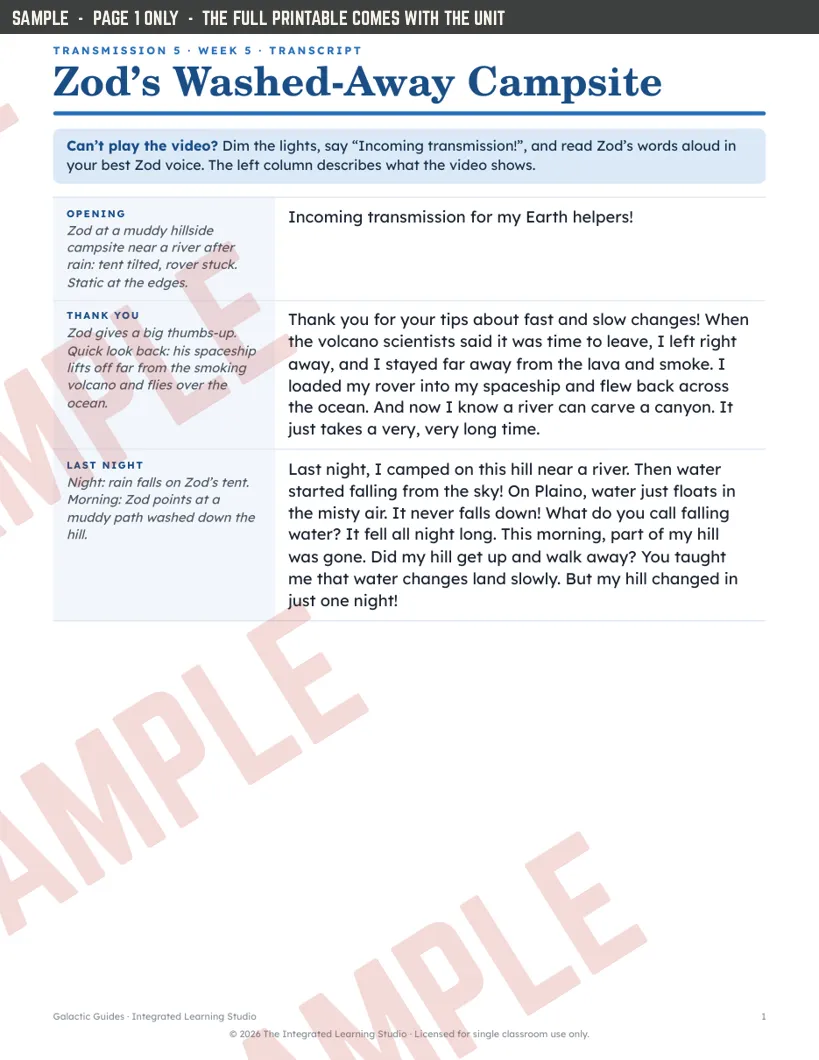
- Get Transmission 5 ready. Play the video, or read the transcript aloud in your best Zod voice.
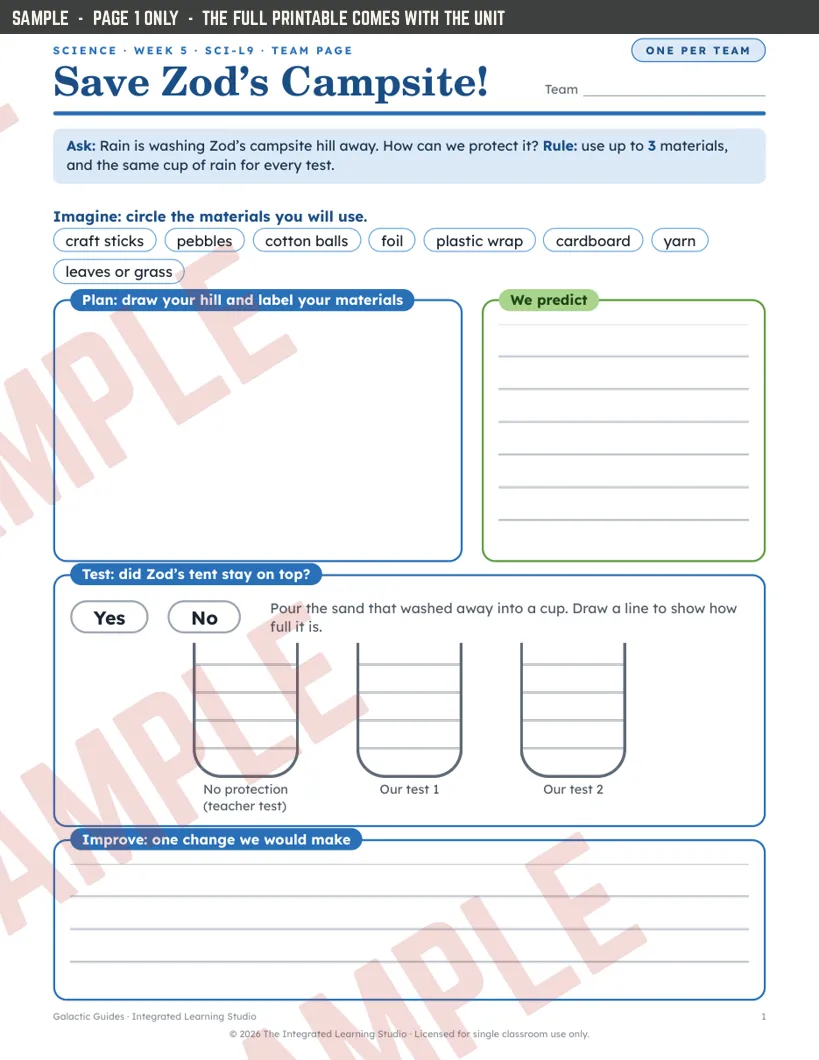
- Print the Erosion Challenge Plan and Test. Print page 1, one for each team, and keep page 2 for yourself. It has the setup steps and a class results chart.
- Make one test hill for the demo. Pack damp sand into a paper cup, flip it onto the middle of a foil pan, and lift the cup. Fold an index card into a tent and stand it on top.
- Make the rain cups. Poke one rain cup for each team plus one for you: a paper cup with five pencil holes in the bottom. Every test uses one measuring cup of water, poured into the rain cup from the same height.
- Set out the materials in bins where teams can choose: craft sticks, pebbles, cotton balls, foil, plastic wrap, cardboard scraps, yarn, and leaves or grass.
- Print the bulletin board cards Prevent and Barrier from the Bulletin Board Printables.
- Choose this week’s Mission Control team, the next team in order.
💡 Teacher Note: Do it outside or over a tub. This is a wet, sandy lesson. Teams can test outside, at a sink, or with their pan set inside a larger plastic tub. Keep paper towels nearby.
1Incoming Transmission!~5 minutes
Dim the lights.
Earth helpers, Zod is calling. It sounds like he had a rough night.
Play Transmission 5, or read the transcript. When Zod asks what falling water is called, let students tell him: rain! Then ask:
What happened to Zod’s campsite? Did his hill really get up and walk away?
Let students correct him: rain carried the sand and soil down the hill. That’s erosion, from Week 4. It is usually slow, but heavy rain can change a hill in one night. If students say “landslide,” agree it’s close: a landslide slides all at once, but this rain carried the soil away bit by bit, all night. Save Zod’s “Flood Watch” question for Friday.
2Add to the Survival Plan~4 minutes
The Mission Control team writes Zod’s newest problem: Rain washed Zod’s campsite away. How do Earthlings stay safe when Earth changes?
Students turn and talk: How could we keep Zod’s hill from washing away? The Mission Control team writes two or three predictions on sticky notes, such as “Put rocks around it” or “Cover it up.”
3Watch It Wash Away~10 minutes
Gather students around your demo hill.
Here is Zod’s campsite with no protection at all. Watch closely. What do you predict will happen when it rains?
Hold the rain cup about a hand’s length above the hill and pour in one measuring cup of water. Students watch the sand slide and the tent tip. Scoop the sand that washed into the pan into a clear cup and set it where everyone can see. This is the cup to beat.
Engineers can’t stop the rain. But they can prevent some of the sand from washing away. Your job is to build a barrier that slows the water down.
Add the Prevent and Barrier cards under We Speak Like Experts. Then play Make Your Own Erosion! (about 4 minutes).
4Ask, Imagine, Plan~7 minutes
Hand each team a Plan and Test page and read the rule together: up to three materials, and the same rain for every test.
- Which materials could hold sand in place?
- Which could keep the rain from hitting the sand?
- Which could slow the water down?
Teams circle their materials, draw and label their plan, and write a prediction.
5Build and Test~15 minutes
Each team builds a fresh hill, adds its protection, and sets the tent on top. When a team is ready, pour the rain for them, or let one team member pour while you watch the height. Teams scoop their washed-away sand into a clear cup, circle Yes or No for the tent, and draw the sand line on their page.
Teams with time left make one change and test again, then draw a second cup.
💡 Teacher Note: A fair test. Same hill, same amount of water, same height. If one team pours from higher up, their results can’t be compared. Ask, “Did every team get the same rain?”
6Compare Solutions~10 minutes
Line up every team’s clear cup next to the no-protection cup. Fill in the class results chart on page 2 as teams share.
Which designs kept the most sand on the hill? What do they have in common?
Look for answers like these: covering the hill kept the rain off, pebbles stayed put and held the sand, walls of craft sticks slowed the water.
People on Earth do the same thing. They plant grass and trees, because roots hold soil in place. They build rock walls and cover bare dirt.
Show the first part of Soil Erosion and Conservation to see real solutions, such as trees, grass, and steps cut into hills.
7What We Learned~4 minutes
The Mission Control team adds sticky notes to What we learned, such as “Rain can wash a hill away” or “Covers, rocks, and plants slow erosion.”
What to notice during the lesson
Look for students who explain why their design worked or didn’t, use the cups to compare two designs, and connect a classroom design to a real solution such as plants or walls.
In Lesson 10, pairs bring back their Week 2 rovers and upgrade them for mud, a steep hill, and a heavy load. Keep the class results chart; the best tips go to Zod on Friday.
| Subject | Connection |
| Science (Week 4) | Slow changes: students saw water carry sand away in the erosion stations. Now they slow it down. |
| Social Studies | In Lesson 5, students learn who helps when Earth changes fast, like in a flood. |
| Writing | Students who chose a place shaped by water, like the Grand Canyon or the Mississippi River, can add how people protect the land to their chapter. |
- NGSS · 2-ESS2-1 — Compare multiple solutions designed to slow or prevent wind or water from changing the shape of the land.Lesson connection: Teams test ways to protect a sand hill from rain and compare every team’s results.
- NGSS · K-2-ETS1-1 — Ask questions, make observations, and gather information about a situation people want to change to define a simple problem that can be solved through the development of a new or improved object or tool.Lesson connection: Students watch an unprotected hill wash away and define the problem they need to solve.
- NGSS · K-2-ETS1-2 — Develop a simple sketch, drawing, or physical model to illustrate how the shape of an object helps it function as needed to solve a given problem.Lesson connection: Teams draw and label their plan, then build it on the hill.
- CCSS.ELA-LITERACY.SL.2.2 — Recount or describe key ideas or details from a text read aloud or information presented orally or through other media.Lesson connection: Students explain what happened to Zod’s campsite after Transmission 5.
© 2026 The Integrated Learning Studio · Licensed for single classroom use only.