🧭 Teaching Sequence: Week 3, first science lesson. Teach before Social Studies Lesson 3.
| Subject | Science: Life Science |
| Week Theme | Survive the Seasons |
| Lesson | Blubber Glove Experiment |
| Time | About 55 minutes, plus setup |
| Grade Level | 2nd Grade (adaptable for Grades 1–4) |
| Resources | Blubber Glove Examples · Levels of Cold · Blubber Glove Record Sheet · Habitat and Adaptations Bulletin Board Printables (page 24) · Great Migrations: Amazing Animal Journeys · Georgia Aquarium: Blubber and Adaptations (7 minutes) |
| Materials | Gallon and sandwich zip bags; duct tape; 3 cups of shortening (such as Crisco); cotton balls; dish towels; 3 tubs of ice water; ice; thermometers; paper towels |
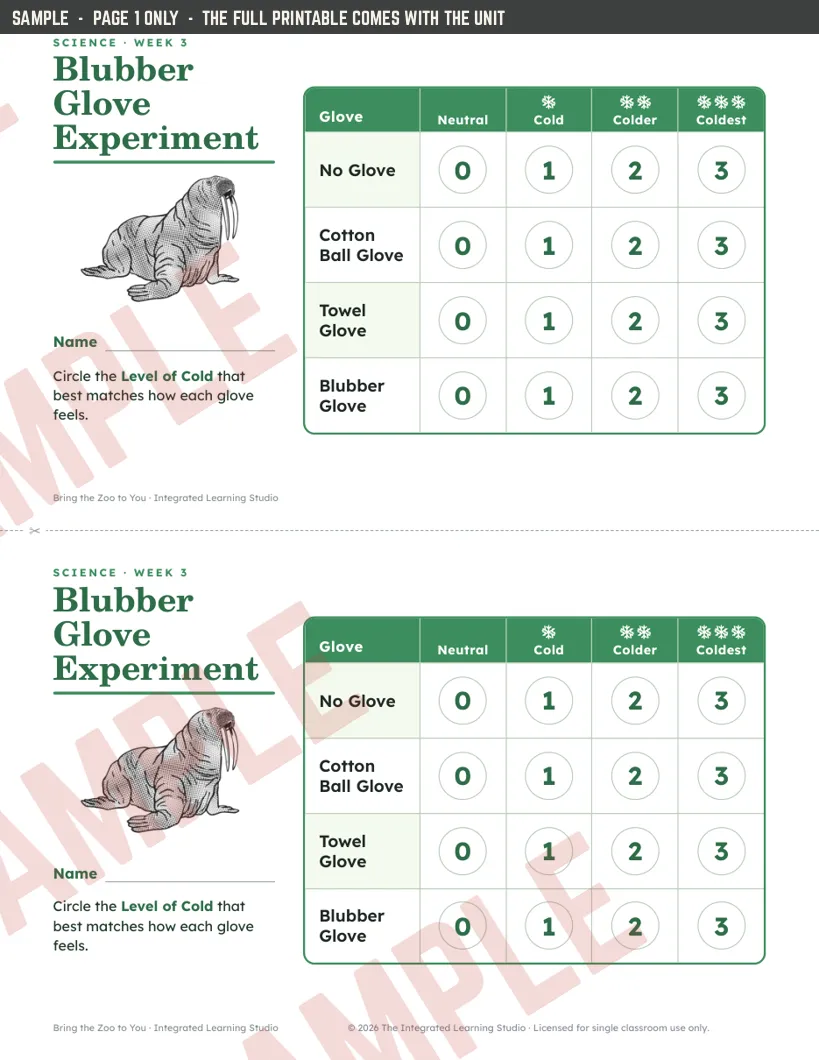
| Student Product | A record sheet rating how cold each glove felt |
Students will test how a layer of fat keeps an animal warm and explain why blubber is a physical adaptation for very cold habitats.
Tell students: “I can explain how blubber helps animals survive in cold places.”
Students feel the difference blubber makes. They compare a blubber glove with the ways people stay warm (layers and a puffy coat), first by how it feels and then with a thermometer.
Vocabulary: We Speak Like Experts
Blubber: A thick layer of fat that keeps animals warm in very cold habitats.
How can we create a class zoo that helps visitors understand animals and the places they call home?
Tell students: “An Arctic animal's zoo exhibit has to stay cold. Today we learn how its body handles that cold.”
- Make three gloves. For each, put the sandwich bag inside the gallon bag with the openings lined up. Fold the top of the sandwich bag down over the outside of the gallon bag, then duct tape around the fold so nothing can escape the gallon bag. The sandwich bag stays open for a hand. The Blubber Glove Examples show a finished glove in use (page 1) and a labeled photo with build steps for all three gloves (page 2).
- Blubber glove: shortening between the two bags. Squish it around so it covers the hand area.
- Cotton ball glove (a puffy coat): cotton balls between the bags.
- Towel glove (layers of clothes): dish towels wrapped around the inner bag.
- Fill 3 tubs with ice water just before the lesson, one per station.
- Print the record sheets (two per page) and bulletin board page 24 (Blubber).
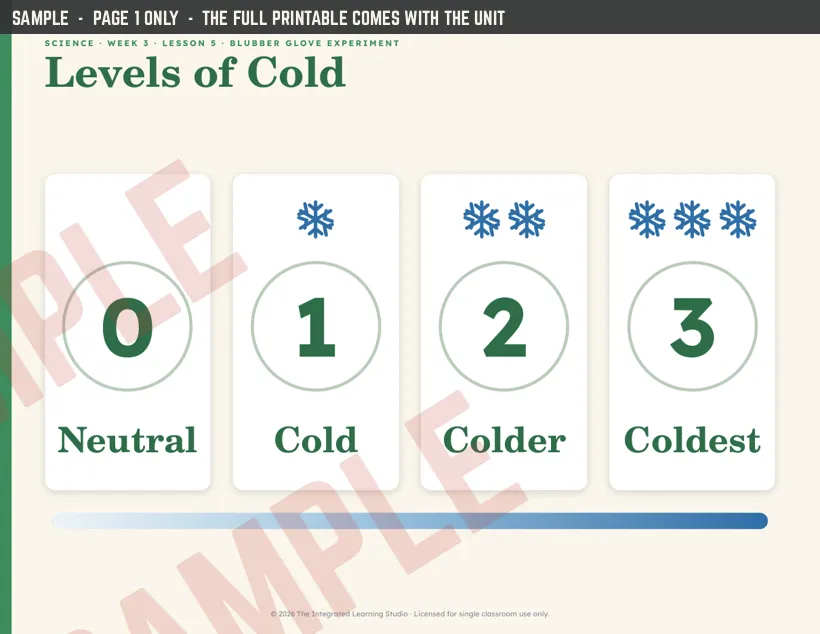
- Project the Levels of Cold slide.
💡 Teacher Note: Keep it safe. Limit each hand in the ice water to about 30 seconds, and keep paper towels at every tub.
1Welcome to the Arctic~3 minutes
Read aloud:
Imagine a place where the ground is covered in sparkling white snow and shiny ice as far as your eyes can see. The air is so cold it feels like tiny pinches on your cheeks, and your breath puffs out like a little cloud. This is the Arctic! It's one of the coldest places on Earth, where winter nights last for weeks and the sun doesn't rise at all. The wind howls like a pack of wolves, and snowstorms can make it hard to see your own hands. The animals here need special adaptations to survive!
2Meet the Walrus~10 minutes
Open Great Migrations to page 30. Study the walrus diagram, especially the word blubber and its definition. Then read through page 41 to learn about walrus migration.
Add blubber and the walrus picture to the bulletin board under physical adaptations.
3How Do People Stay Warm?~4 minutes
What would we need to visit the Arctic?
Students will say to dress warmly. Hold up the towel glove (layers of clothes) and the cotton ball glove (a puffy coat).
These are things people use to stay warm. Today we'll test how well they work.
4The Blubber Glove~5 minutes
Hold up the blubber glove.
What could this one stand for?
Explain that the shortening is fat, like a walrus's blubber. Have a few volunteers put a bare hand in the ice water and count the seconds together.
5Test the Gloves~15 minutes
Point to the Levels of Cold slide: 0 is neutral, 1 is cold, 2 is colder, and 3 is coldest. A bare hand in ice water is a 3, so students circle 3 in the No Glove row.
Split the class into 3 groups, one per tub. Students try each glove, decide how cold it feels, and circle a level on their record sheets. Rotate the gloves between groups.
6Check with a Thermometer~8 minutes
You described how cold each glove felt. That's information in words. Now let's get information in numbers.
Take the temperature of the ice water. Then put a thermometer inside each glove, set the glove in the ice water, and wait 2 minutes. Write each temperature on the board.
Did the numbers match how the gloves felt? Which glove kept the cold out best?
7Wrap Up and Video~10 minutes
Blubber is a physical adaptation. It helps animals like walruses, whales, seals, polar bears, and penguins live in very cold habitats.
Watch the Georgia Aquarium video to review.
What to notice during the lesson
Look for students who rate each glove, compare their feelings with the thermometer readings, and explain how blubber keeps an animal warm.
In Lesson 6, students explore a different physical adaptation: camouflage. In Social Studies Lesson 3, students see how a cold place changes across the seasons.
| Subject | Connection |
| Reading | Students use a diagram and its labels to learn a new word. |
| Math | Students read thermometers and compare temperatures. |
| Social Studies | Students connect cold habitats to the climate words from Lesson 2. |
- NGSS · 2-LS4-1 — Make observations of plants and animals to compare the diversity of life in different habitats.Lesson connection: Students observe how a cold-habitat adaptation works and compare it with ways people stay warm.
- CCSS.ELA-LITERACY.RI.2.7 — Explain how specific images (e.g., a diagram showing how a machine works) contribute to and clarify a text.Lesson connection: Students use the walrus diagram to understand the word blubber.
- CCSS.ELA-LITERACY.W.2.7 — Participate in shared research and writing projects (e.g., read a number of books on a single topic to produce a report; record science observations).Lesson connection: Students record how cold each glove feels on a record sheet.
- NGSS · K-2-ETS1-3 — Analyze data from tests of two objects designed to solve the same problem to compare the strengths and weaknesses of how each performs.Lesson connection: Students compare how well three gloves keep out the cold, by feel and with a thermometer.
- Georgia Aquarium: Blubber and Adaptations
- NGSS 2-LS4-1 · CCSS Grade 2 Reading: Informational Text
© 2026 The Integrated Learning Studio · Licensed for single classroom use only.